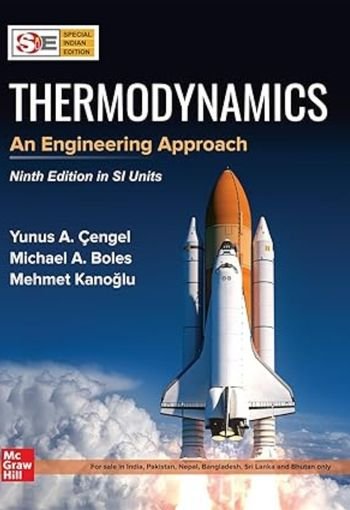
Thermodynamics: An Engineering Approach 9th Edition – Comprehensive Engineering Textbook for Students and Professionals
About the Book
Thermodynamics: An Engineering Approach is the gold standard textbook that has guided millions of engineering students worldwide. The 9th edition continues its tradition of making thermodynamics accessible and engaging through systematic explanations, visual learning aids, and hundreds of worked examples. Whether you’re studying mechanical, chemical, civil, or aerospace engineering, this book builds your foundation in energy systems, heat transfer, and thermodynamic cycles with clarity and precision. Every chapter connects theory to practice, helping you understand not just the “how” but the “why” behind thermodynamic principles.
About the Authors
Yunus A. Çengel is an acclaimed professor and author known for his exceptional ability to simplify engineering concepts. With decades of teaching experience at top universities, Dr. Çengel has authored multiple bestselling engineering textbooks. Michael A. Boles brings extensive research expertise in thermodynamics and energy systems, combining academic rigor with practical industry insights. Together, they’ve created a learning resource that balances theoretical depth with application-focused teaching.
Who Is This Book For?
This textbook is essential for undergraduate engineering students taking thermodynamics courses, graduate students refreshing their fundamentals, and practicing engineers seeking a reliable reference guide. If you’re pursuing a degree in mechanical, aerospace, chemical, or energy engineering, this book will be your companion throughout your academic journey and professional career. It’s also valuable for self-learners who want to build a solid understanding of thermal sciences and energy conversion processes.
Frequently Asked Questions
Q: Is this the international edition or US edition of Thermodynamics 9th Edition?
A: This is the standard 9th edition paperback. It contains the complete content used in engineering programs worldwide with all chapters, examples, and problem sets intact.
Q: Does the book include solutions to thermodynamics problems?
A: The textbook contains numerous worked examples with detailed solutions throughout each chapter. Separate solution manuals for end-of-chapter problems are typically available through academic channels or the publisher.
Q: What topics are covered in Thermodynamics: An Engineering Approach?
A: The book covers fundamental concepts, properties of pure substances, energy analysis, entropy, power cycles (Rankine, Brayton, Otto, Diesel), refrigeration systems, thermodynamic relations, gas mixtures, and psychrometric applications.
Q: Is this thermodynamics book good for self-study?
A: Yes, the book is written with clear explanations, visual aids, and progressive difficulty that makes it excellent for self-paced learning. Many engineers use it as a reference guide even after graduation.
Q: What’s new in the 9th edition compared to earlier versions?
A: The 9th edition features updated examples, improved illustrations, expanded coverage of renewable energy systems, revised problem sets, and enhanced digital learning resources that align with modern engineering education standards.