The Next Day by Melinda French Gates USA
The Next Day by Melinda French Gates Original price was: $10.75.Current price is: $7.74.
Back to products
Speak the Blessing by Joel Osteen
Speak the Blessing by Joel Osteen Original price was: $16.38.Current price is: $13.37.

Quick Dispatch & Fast Delivery

USPS Delivery courier service from bookwharf image

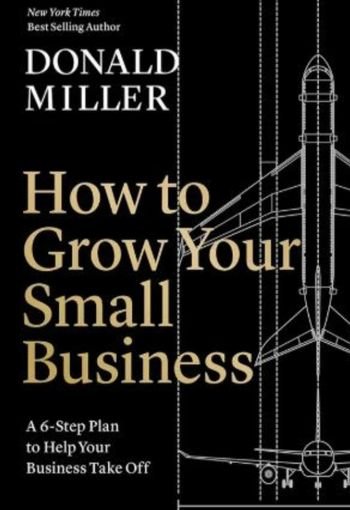
How to Grow Your Small Business by Donald Miller

Original price was: $32.98.Current price is: $29.97.

Binding: Paperback
Language: English
ISBN-13: 978-1400246717
Reader’s Age: Adults 18+ (Entrepreneurs, Business Owners, Leaders)
Ships Within: 5–10 Business Days
Author: Donald Miller
Release Date: March 14, 2023
Genre: Business & Finance

Delivery Time

  • USPS Delivery courier service from bookwharf image USPS Courier delivery (Delivery within USA)

USPS courier will deliver the books safely at your door Step

4-5 Days

  • Standard delivery (Delivery Outside US)

Our courier will deliver books safely at your door step. 

8-10 Days

  • Free 7-Day returns
Description

Master the Proven Framework for Small Business Growth and Long-Term Success

About the Book

Running a small business shouldn’t feel like chaos. In How to Grow Your Small Business, bestselling author and entrepreneur Donald Miller cuts through the noise and delivers a clear, actionable system for sustainable growth. Drawing from years of building successful companies and coaching thousands of business owners, Miller shows you exactly how to create structure, clarity, and momentum in your business. This isn’t theory—it’s a proven framework that transforms overwhelmed entrepreneurs into confident leaders who run profitable, scalable companies.

From the Back Cover

Stop guessing and start growing. This book hands you the blueprint for turning your small business into a thriving enterprise that works for you, not against you.

About the Author

Donald Miller is a renowned business coach, speaker, and CEO who has helped thousands of small business owners clarify their message and grow their companies. As the founder of StoryBrand and Business Made Simple, Miller combines storytelling expertise with practical business strategy. His frameworks are used by entrepreneurs worldwide to create clarity, increase revenue, and build teams that execute with purpose. Miller’s approach is refreshingly simple: give business owners the tools they need to succeed without the MBA jargon.

Who Is This Book For?

This book is perfect for small business owners who feel stuck, overwhelmed, or uncertain about how to grow sustainably. If you’re an entrepreneur struggling to scale beyond six or seven figures, a solopreneur ready to build a team, or a business leader looking for a proven system to bring order to the chaos, this book is your roadmap. It’s also ideal for anyone who wants to lead with confidence, create repeatable success, and build a business that doesn’t depend on their constant presence to survive.

Frequently Asked Questions (FAQs)

Q: What will I learn from Donald Miller’s How to Grow Your Small Business?
You’ll learn a proven system for scaling your small business, including how to create clarity in your operations, build effective teams, implement growth strategies, and develop leadership skills that drive sustainable success.

Q: Is this book good for startups or only established small businesses?
This book works for both. Whether you’re launching a startup or running an established business that’s hit a growth plateau, Miller’s framework helps you build structure and momentum at any stage.

Q: How is Donald Miller’s business growth system different from other books?
Miller focuses on simplicity and execution. Instead of overwhelming theory, you get practical tools and frameworks used by thousands of successful entrepreneurs. It’s designed for busy business owners who need results, not fluff.

Q: Do I need business experience to understand this book?
No MBA required. Miller writes in clear, accessible language that any small business owner can understand and apply immediately. The strategies are practical and designed for real-world implementation.

Additional information
Weight320 g
Dimensions21.8 × 13.5 × 1.3 cm
Short Summary

Inside this book, you'll discover how to create a clear growth plan, build systems that scale, develop leadership skills that inspire your team, and make strategic decisions that move your business forward. Miller breaks down complex business concepts into simple, actionable steps that produce real results. You'll learn how to identify what's holding you back, implement frameworks that drive consistent growth, and create the freedom and profitability you started your business to achieve.

Customer Reviews

1584789707";
Physical books vs digital books comparison guide 2026 — open paperback book being read by hand, featured image for Bookwharf online bookstore blog

Physical Books vs. Digital Books: What the Research Actually Says

Physical books vs. digital books isn’t just a preference question. Studies show print readers tend to score higher on comprehension tests, and screens can quietly mess with your sleep and eye comfort. E-books win on price, portability, and convenience. The best answer depends on what you’re reading and when. Here’s how to choose format by format.

You Don’t Have to Pick a Side, But It Helps to Know the Difference

Ask ten readers whether they prefer physical books or digital books and you’ll get ten different answers, usually followed by a shrug. But the physical books vs. digital books debate isn’t only about nostalgia versus convenience. Researchers have actually measured what happens in your brain, your eyes, and your sleep cycle depending on which one you pick up.

In 2025, print still led the pack in the US, with 46% of adults reading a physical book compared to 24% reading an e-book. That’s not a format in decline. It’s a format holding its ground against every convenience argument digital reading can throw at it. Below is what the research says about comprehension, eye strain, sleep, and cost, so you can pick the right format for the book in front of you instead of guessing.

Open book photographed with soft bokeh lighting

Do You Actually Remember More From a Physical Book?

Yes, and the gap is bigger than most readers expect. A 2023 study by researchers Altamura, Vargas, and Salmerón found that reading comprehension was six to eight times better with physical books than with e-readers, based on data from over 450,000 participants.

Part of the reason comes down to something researchers call the spatial index. When you read a printed page, your brain quietly tracks where information sat on the page and how far you are through the book. Reading researcher Anne Mangen at the University of Stavanger has studied this extensively, and her work suggests that the physical act of holding a book and turning its pages helps build a mental map of the text that supports recall later. An earlier 2018 Stavanger study found printed-text readers scored slightly higher on comprehension tests than digital readers reading the same material.

None of this means e-books are useless for retention. Straightforward narrative fiction shows a smaller gap than dense nonfiction or textbook material. But if you’re reading something you actually want to remember, print has real research behind it. It’s also part of why a physical copy makes such a solid gift for the reader in your life who wants to actually sit with a book, not just add it to a device.

Person reading a physical book at a wooden table during the day
Physical Books vs. Digital Books image

Why Physical Books Are Easier on Your Eyes

Print doesn’t fight your blink rate the way backlit screens do. Research on reading comfort has found that your blink rate can drop by around 60% when reading on a digital screen compared to a printed page, which is a big part of why longer screen sessions leave your eyes feeling dry and tired in a way a paperback doesn’t.

Not all screens are equal here. A comparative study published in Ophthalmic and Physiological Optics found that reading on a backlit LCD tablet caused noticeably more visual fatigue than reading on an e-ink display or a printed book, which behaved almost identically to paper. So if you’re committed to digital reading, a dedicated e-ink reader is a much gentler choice for your eyes than reading on a phone or tablet.

Does Reading on a Screen Wreck Your Sleep?

It can, especially if you’re reading right up until lights out. Blue light from phones, tablets, and laptops suppresses melatonin, the hormone that signals your body it’s time to sleep. The Sleep Foundation notes that blue light exposure before bed can delay your natural sleep-wake cycle and make it harder to fall asleep and stay asleep.

UCLA Health recommends ending screen use two to three hours before your target bedtime to avoid that effect entirely, which is a tall order if your nightly reading habit lives on a phone or backlit tablet. A physical book sidesteps the issue completely. No blue light, no notifications, and no reason to “just check one thing” mid-chapter. If reading before bed is part of your routine, and it’s a habit worth building either way, a paperback on your nightstand does the job without any of the sleep tradeoffs.

Person lying in bed reading on a phone screen at night

The Focus Factor: Fewer Notifications, More Immersion

Reading on paper tends to be a slower, more single-tasked activity. There’s no email badge, no group chat, no algorithm nudging you toward one more scroll. Reading on a phone or tablet puts your book one swipe away from everything else competing for your attention.

That’s not a knock on e-readers as a category. A dedicated e-ink device, without social apps or a browser, keeps most of that print-like focus. It’s backlit tablets and phones where the distraction risk climbs, simply because the book is sharing space with everything else you use that screen for.

Where E-books Actually Win: Cost, Space, and Convenience

To be fair to digital reading, it earns its popularity honestly. In 2026, new hardcover bestsellers averaged $20.42 on Amazon, compared to $12.99 for the e-book version, a real savings if you’re working through a long TBR list on a budget.

E-books also win outright on:

  • Space. A single device holds hundreds of titles, no shelf required.
  • Instant access. No waiting on shipping when you want to start reading tonight.
  • Portability while traveling. One device instead of a stack of paperbacks in your carry-on.
  • Adjustable text size. A genuine advantage for readers with vision changes or presbyopia.

Print isn’t going anywhere either. U.S. print book sales reached roughly 762 to 782 million units in 2025, and BookTok’s momentum has continued to push physical copies rather than replace them with digital ones. This is really a “both, depending on the book” situation rather than a winner-take-all one, and browsing a wide, budget-friendly selection online makes it easy to build a print shelf without paying full retail for it.

Amazon Kindle e-reader showing an open book on screen

Building a Reading Habit That Sticks

The best format is the one that actually gets you to open the book. If screens pull you toward social media instead of your Kindle app, a stack of paperbacks by your couch removes that temptation entirely. If you travel constantly, a lightweight e-reader might be what keeps you reading at all.

A few habits help regardless of format:

  • Keep books visible. A shelf or a nightstand stack works as a reminder in a way a buried app icon doesn’t.
  • Match format to context. Print for bedtime and deep nonfiction, digital for travel and quick reads.
  • Set a small daily target. Even 15 to 20 minutes compounds fast over a month.

If you want a more structured approach, this guide to building a daily reading habit walks through routines that work even on busy weeks.

The Bottom Line

Physical books have real, research-backed advantages: better comprehension, less eye strain, and no sleep disruption from blue light. E-books win on price, portability, and convenience, especially while traveling. Most readers end up using both, print for the books they want to sit with and remember, digital for everything else.

If you’re leaning back toward paper, you can browse fiction titles here at prices well below retail, no need to choose between your reading habit and your budget.

FAQ

Is it actually true that physical books improve memory more than e-books?

Research points that direction. A 2023 study found comprehension scores six to eight times higher for physical book readers than e-reader users, and earlier research from the University of Stavanger found similar, if smaller, gaps in comprehension testing.

Do e-readers cause the same eye strain as phones and tablets?

Not exactly. Dedicated e-ink readers behave much more like paper, with far less visual fatigue than backlit LCD screens like phones and tablets. If eye comfort matters to you and you still want to read digitally, an e-ink device is the better pick.

Why does reading on my phone before bed keep me up longer?

Blue light from phone and tablet screens suppresses melatonin production, which delays your body’s natural signal that it’s time to sleep. Experts recommend stopping screen use two to three hours before bedtime to avoid this.

Are e-books actually cheaper than physical books?

Usually, yes. New hardcover bestsellers average around $20 while their e-book counterparts run closer to $13, though prices vary by title, format, and retailer.

Is print book reading actually declining because of e-books?

No. Print remains the most-read format in the US, with hundreds of millions of units sold annually, and sales have stayed steady even as digital reading has grown. Most data suggests the two formats are expanding reading overall rather than competing for the same readers.