Master Probability Theory Through the Lens of Scientific Reasoning and Bayesian Logic
About the Book
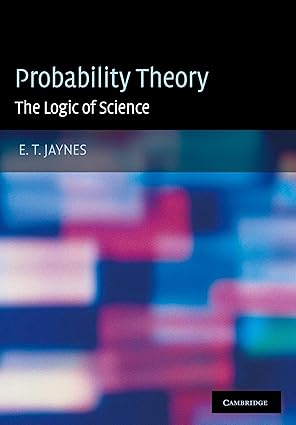
Probability Theory: The Logic of Science represents one of the most important contributions to scientific methodology in modern times. Written by renowned physicist E.T. Jaynes, this masterwork presents probability theory not as a branch of mathematics concerned with random events, but as an extension of logic that allows us to reason consistently when we don’t have complete information. The book bridges the gap between abstract mathematical theory and practical scientific problem-solving, making it invaluable for researchers who need to make inferences from limited or uncertain data.
From the Back Cover
“Probability theory is nothing but common sense reduced to calculation.” – Pierre-Simon Laplace
This hardcover edition brings together decades of Jaynes’ insights into how scientists should think about probability, offering a coherent philosophical foundation that has influenced fields from physics to machine learning.
About the Author
E.T. Jaynes (1922–1998) was a distinguished Professor of Physics at Washington University in St. Louis and a pioneer in applying Bayesian methods to physics and information theory. His work on maximum entropy principles and statistical mechanics earned him recognition as one of the most original thinkers in 20th-century physics. Jaynes spent much of his career developing the ideas in this book, which was completed and edited by his colleague G. Larry Bretthorst after Jaynes’ passing, ensuring his revolutionary vision reached the scientific community.
Who Is This Book For?
This book is essential for graduate students, researchers, and professionals in physics, statistics, engineering, economics, and data science who want to master the logical foundations of probability. If you’ve ever felt that traditional probability courses missed something fundamental, or if you work with uncertain data and need rigorous methods for scientific inference, this book will change how you approach problems. It’s particularly valuable for those interested in Bayesian methods, machine learning, or anyone who wants to understand the deep connection between probability and rational thinking.
Frequently Asked Questions (FAQs)
Q: Is this book suitable for beginners in probability theory?
A: This book is best suited for readers with some background in calculus and basic probability. While Jaynes explains concepts clearly, the material is graduate-level. Undergraduates in STEM fields with strong math skills can benefit, but complete beginners should start with introductory probability texts first.
Q: How does this book differ from traditional probability textbooks?
A: Unlike conventional approaches that treat probability as studying random phenomena, Jaynes presents probability as extended logic for reasoning under uncertainty. This Bayesian perspective emphasizes probability as quantifying degrees of plausibility rather than long-run frequencies, making it more applicable to real scientific problems where we can’t repeat experiments infinitely.
Q: What are the practical applications of the methods in this book?
A: The techniques apply broadly to scientific inference, data analysis, machine learning, signal processing, physics, and any field requiring decisions under uncertainty. Readers use these methods for parameter estimation, model comparison, experimental design, and solving inverse problems where traditional statistics falls short.
Q: Do I need programming skills to benefit from this book?
A: No programming is required to understand the concepts, though computational skills help apply the methods. The book focuses on the logical and mathematical foundations. Many readers complement their study by implementing algorithms in Python or R to solve real problems using the principles Jaynes describes.
Q: Why is the hardcover edition worth investing in?
A: This comprehensive 753-page reference book is built for repeated use throughout your career. The hardcover format ensures durability for a volume you’ll return to regularly. Many professionals consider it an essential desk reference that provides both theoretical depth and practical guidance for tackling complex inference problems











Reviews
Clear filtersThere are no reviews yet.